Monday, March 29, 2010

Why?

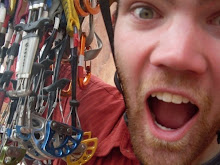
After ten days of climbing in Joshua Tree National Park, I found my self back in Salt Lake City. While in Joshua Tree, a question was raised, why climb? For any discipline of mountaineering, I don't think one can really answer the question. Yet, it is an interesting question to pose.


Why would or do you climb?

Perhaps for my self, a quote by Fyodor Dostoyevsky summerizes it best
"Only through suffering can we find ourselves."

Saturday, March 20, 2010

Contrived posting


When are we neeeded? In expiential education there is a need to find balance in facilitaing only when needed. Much of what we do on rope courses or other settings, can be contrived experices. The participant, is purposely led to a metaphor. Yet, true learning does not come from the class room, it does not come from a contrived event. Learning that has a lasting impact comes from the experience.

"Teach only when cornered, otherwise let the people learn."
- Keith King


While we need to achives intended outcomes, finding the balance in the use of contivencies is crucial in having a real, meaningful experience.

Monday, March 15, 2010

Yes... it was stable.


I decided this week to devatate from my normal topic of experiential education. This experience reminded me of how amazing ski mountaineering can be in the Wasatch.

This season has been far from stable. In the Wasatch Range several Persistent Weak Layers (PWL) have plagued the snow pack. A line that was over thirty degrees would be pushing the limits of stability, and any line of thirty five degrees has been suicidal. Fortunately, this past week was a welcomed change of pace. Brian Ballard, Mark, and myself set out for a high point – Mount Superior. We decided that if nothing else we would summit along the east ridge and have the ability to descend along the same route.


"Powder snow skiing is not fun. It's life, fully lived, life lived in a blaze of reality."
-Dolores LaChapelle


The north east aspect was our line of descent. Fortunately, the snow pack was stable enough to ski! With the direction of wind loading over night and new snow, the stability was incredible. In fact, my primary concern was a minor amount of sluffing. The runs were incredible, with amazing powder for 1700 feet. However, stability in a snow pack changes. While our runs on Wednesday were manageable, I would strongly discourage anyone from repeating the descent – In the past several days warming and wind loading have created dangerous conditions.

Monday, March 8, 2010

Reflection


How many of us reflect? Better question maybe, how many of know how to reflect?

"The Unexamined Life is Not Worth Living”
-Socrates


Reflecting is a life skill - one that is learned though reflection. An individual finds the real meaning of an experience through reflecting. I believe many of us do not understand or poses the skill of reflecting. We live hurried lives, and do not take the time to slow down, and simply reflect on what has happened. Further more, we miss the opportunity to sit still, an simply "examine our lives."

As an experiential educator, reflection is an critical component in what we facilitate. Without it, the experience it self is simply an experience. Reflecting and Processing, allows participants to explore the meaning of the experience and draw from it meaning that can be transferred into everyday life.

Monday, February 22, 2010

Anything worth doing, is worth doing well.

What is good enough?
In our western culture we have a notion that perfection is necessary to achieve excellence. We may achieve near perfect, yet find our selves or others telling us to refine in hopes of attaining perfection. In education, whether experiential or not, what happens when we become more concerned with engagement rather than attainment?

I believe it is exciting to redefine what is good enough. As an experiential educator, I can free my self from concern of a level of effort, and refocus on the experience itself. In other words, aiding students in developing the skills to identify for themselves what is and is not important in achieving excellence. Even in our day to day lives, what is good enough becomes a relative question. What tasks truly deserve our attention?

I purposely leave this post here. Instead of trying to define what is good enough, I leave with a finishing quote, so that you can choose weather or not it is a task that deserves your attention.

"Anything worth doing is worth doing poorly"
-Chesterton

Monday, February 8, 2010

Overconfidence + a bad snowpack = a really bad time


Experience is a critical element at play in how we all perceive numerous types of risks in the backcountry. As of late, I have begun to wonder why so many have tempted fate in the Wasatch. Maybe it is our past experiences of what is and is not safe in another season. Yet, this season has been drastically different. Our snow pack has been more reminiscent of conditions found in our neighboring state Colorado.
The video above, is the story of several friends touring in Montana. I believe it serves the purpose to remind us all of the ever present dangers when heading into the backcountry.

Monday, February 1, 2010

A contrived dialectic

As an experiential educator there are lofty, unattainable goals set forth. One that I have been toying with for sometime now is that of contrived experiences. More specifically, how to facilitate towards an intended outcome, yet not manipulate the experience to achieve said outcomes. Confused? Perhaps put into terms of a dialectic, will presents a more understandable notion.

On one end of the dialectic, an educator takes their students into the wilderness and waits to see what will happen. As the experience unfolds they patiently intervene only when needed. Perhaps as the experience begins to reach an end there is an outcome that is identified, but, the experience my turn out to simply be a walk in the woods.

On the other end, and educator has designed an experience to meet specific outcomes. As the experience begins goals and objectives are laid forth. Each part of the experience is used towards obtaining the ultimate outcome.

In either case, there is a need for a middle ground. Wherein the educator sits back and allows the experience to truly take place. And at times the educator does not intervene only till it is absolutely necessary. There is no right or wrong, rather there is a time and place for each approach taken along such a dialectic - and it is by experience that an experiential educator can effectively facilitate in such a way that is appropriate.